
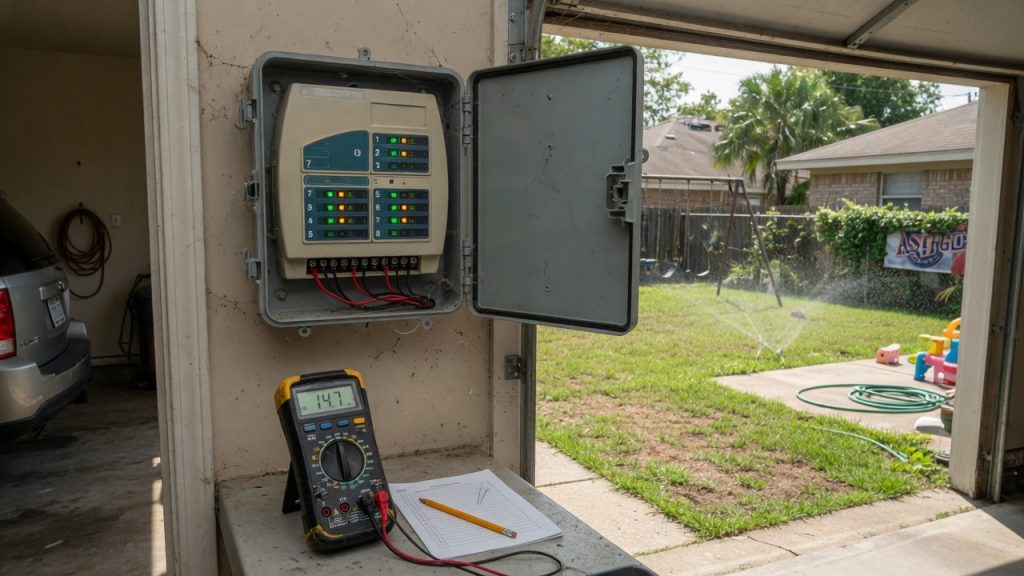
Start with the controller, not the head
Greater Houston is one of the toughest irrigation environments in Texas. Expansive clay soils, long summers, intense rainfall events, and aggressive turf growth combine to stress valves, laterals, heads, and controllers. This guide — Irrigation Zone Not Working? A Houston Homeowner Checklist — is written for homeowners, property managers, and HOA board members who want technical clarity before they authorize repairs. Whether you are in Cypress irrigation repair, Spring irrigation repair, or The Woodlands irrigation repair, the diagnostic order below prevents parts-roulette spending.
A silent zone is the most common service call in the Houston metro. The failure might be electrical, hydraulic, or simple programming. If you start by buying a new sprinkler head, you are guessing. Begin at the controller: is the station programmed, is seasonal adjust above zero, does the station indicator respond when you run it manually, and is a rain sensor holding the system off?
Field checks before you dig
Inspect the rain/freeze sensor and try sensor bypass if equipped. Confirm isolation valves at the backflow or manifold are open. Open the valve box if you can find it and look for standing water, chewed wires, or a solenoid that will not open with a manual bleed.
When those checks fail, move to professional testing: ohms on the solenoid circuit, voltage at the valve, and hydraulic operation. That is the core of Zone Not Working Diagnostics.
Electrical causes of a dead zone
Open circuits from cut wires, high-resistance bad splices, shorted common wires, and failed solenoids are frequent after landscaping, fence installs, and edging. Multimeter readings tell a clear story when interpreted correctly — and they prevent replacing valves that still work.
Controller output problems are less common than field wiring faults but still happen after storms. Valve Repair & Replacement covers board, transformer, and station driver failures.
Hydraulic causes of a dead or weak zone
Torn diaphragms, debris on seats, closed valves, collapsed poly, and nozzle packing all create weak or silent stations. Pressure gauges and systematic isolation separate a lateral restriction from a valve that never opens.
If the zone runs continuously instead of staying silent, switch mental models to a stuck valve and treat it as urgent — see our valve guides and Controller & Timer Repair.
A practical order of operations
Program check → sensor bypass → isolation valves → valve box inspection → electrical test → hydraulic test → targeted repair → full retest. That order saves money on every Houston property type, from townhomes to commercial manifolds.
Homeowners in Cypress irrigation repair, Spring irrigation repair, and The Woodlands irrigation repair can complete the first three steps safely; leave live wiring and excavation to licensed technicians.
Technicians document station numbers, valve locations when found, and parts used so the next visit is faster. On commercial sites, that documentation is often required by property managers and HOA boards.
Houston’s irrigation season effectively runs much of the year. Controllers that sit idle still suffer from heat in garages and power events. A quick off-season check of transformer voltage and sensor status prevents spring surprises.
When excavation is required, clean trench walls, correct bedding, and a pressure hold test are non-negotiable quality steps. Closing a trench without a test is how callbacks happen two waterings later.
Parts selection matters: matching valve brands where possible, using waterproof wire connectors, and choosing nozzles for measured pressure beats installing whatever is cheapest on the truck.
If your system was installed by a production builder, expect original splice quality and head spacing to vary. A diagnostic visit often becomes a punch-list of small corrections that dramatically improve coverage.
Water waste is not only environmental — it is a direct operating cost for HOAs and commercial managers. Fixing stuck valves and misting heads frequently pays for the service call within a billing cycle or two.
Maintenance checklist you can reuse
Monthly in season: walk zones while running, look for misting, heads stuck up, and dry wedges. Quarterly: open a sample of valve boxes, check for standing water and chewed wires. Annually: verify rain sensor operation, update seasonal adjust, and confirm backflow testing status with your local requirements.
Keep a simple note on your phone: controller brand/model, number of stations, location of backflow, and any gate codes. That five-line note saves real time on every service visit across the Houston metro.
Water waste is not only environmental — it is a direct operating cost for HOAs and commercial managers. Fixing stuck valves and misting heads frequently pays for the service call within a billing cycle or two.
Technicians document station numbers, valve locations when found, and parts used so the next visit is faster. On commercial sites, that documentation is often required by property managers and HOA boards.
Houston’s irrigation season effectively runs much of the year. Controllers that sit idle still suffer from heat in garages and power events. A quick off-season check of transformer voltage and sensor status prevents spring surprises.
When excavation is required, clean trench walls, correct bedding, and a pressure hold test are non-negotiable quality steps. Closing a trench without a test is how callbacks happen two waterings later.
Parts selection matters: matching valve brands where possible, using waterproof wire connectors, and choosing nozzles for measured pressure beats installing whatever is cheapest on the truck.
If your system was installed by a production builder, expect original splice quality and head spacing to vary. A diagnostic visit often becomes a punch-list of small corrections that dramatically improve coverage.
Water waste is not only environmental — it is a direct operating cost for HOAs and commercial managers. Fixing stuck valves and misting heads frequently pays for the service call within a billing cycle or two.
Technicians document station numbers, valve locations when found, and parts used so the next visit is faster. On commercial sites, that documentation is often required by property managers and HOA boards.
Houston’s irrigation season effectively runs much of the year. Controllers that sit idle still suffer from heat in garages and power events. A quick off-season check of transformer voltage and sensor status prevents spring surprises.
Related guides and local pages
- Low Water Pressure on One Irrigation Zone in Houston
- Finding and Fixing Irrigation Wire Breaks
- HOA Common-Area Irrigation: What Boards Should Require
- Zone Not Working Diagnostics
- Valve Repair & Replacement
- Controller & Timer Repair
- Cypress irrigation repair
- Spring irrigation repair
- The Woodlands irrigation repair
Need irrigation repair in Houston? Call (346) 627-2400 or request service online. Houston Irrigation Repair serves Harris, Fort Bend, Montgomery, Brazoria, Galveston, and Waller counties with full-system diagnostics.
Keep reading
- Finding and Fixing Irrigation Wire Breaks
- Do Houston Irrigation Systems Need Winterization?
- Smart Irrigation Controllers in Houston: Worth It in Gulf Weather?
- Commercial Rotor Coverage Problems on Large Turf
- Stuck Irrigation Valve: Why a Zone Will Not Shut Off
- After a Houston Freeze: Prioritize These Irrigation Checks
Related irrigation services
Service areas
Need help with your system?
Call Houston Irrigation Repair at (346) 627-2400 for full-system diagnostics and repair across the Houston metro.