
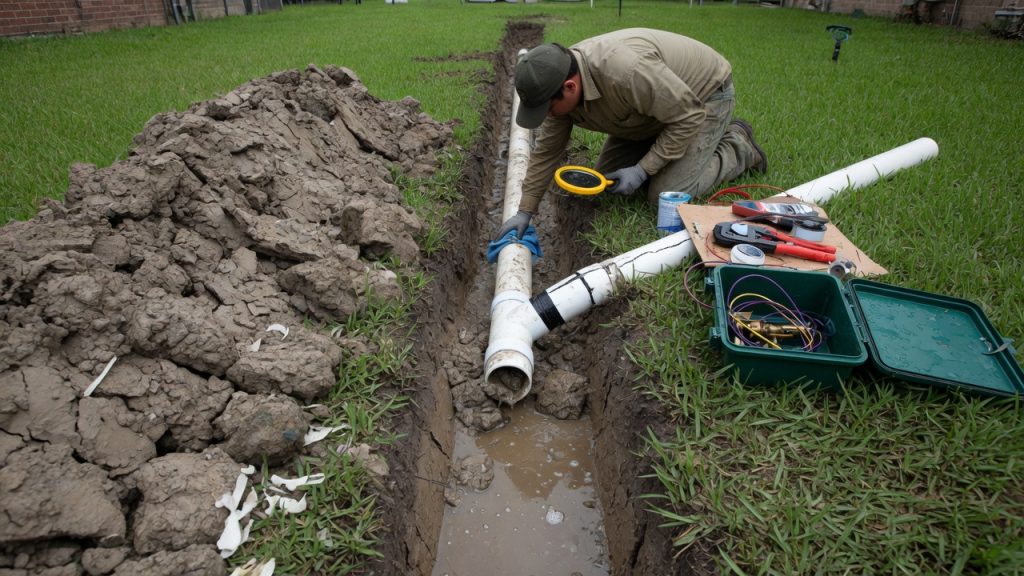
Why Houston clay destroys irrigation laterals
Greater Houston is one of the toughest irrigation environments in Texas. Expansive clay soils, long summers, intense rainfall events, and aggressive turf growth combine to stress valves, laterals, heads, and controllers. This guide — How Houston Clay Soil Causes Irrigation Leaks (And What to Do) — is written for homeowners, property managers, and HOA board members who want technical clarity before they authorize repairs. Whether you are in Houston irrigation repair, Katy irrigation repair, or Sugar Land irrigation repair, the diagnostic order below prevents parts-roulette spending.
Beaumont and similar clay series swell when saturated and shrink when dry. That seasonal movement flexes PVC joints, pulls fittings out of alignment, and opens hairline cracks that only show when a zone is pressurized. In older neighborhoods inside the Loop, brittle pipe and shallow installs make the problem worse. In master-planned communities, long side-yard laterals under sidewalks are classic failure points after a few wet-dry cycles.
Clay also hides leaks. Water can travel along the pipe trench and surface far from the break, or it can saturate a low area and look like poor drainage. That is why visual guessing is expensive. A structured leak investigation pairs meter observation, zone isolation, and careful excavation.
Symptoms that point to clay-related pipe failure
Watch for soggy strips when the system is off, unexplained spikes on the water bill, a single zone that is weak while others are strong, erosion near sidewalks, or a meter that creeps with every irrigation station idle. Foundation-adjacent wet spots deserve urgent attention because Houston slabs and clay moisture are a bad combination.
If you only replace the nearest head, you often miss the lateral crack two fittings away. Our Pipe & Lateral Leak Repair process is built for that reality.
How professionals diagnose leaks in clay
Technicians start by confirming whether the leak is continuous (mainline or valve weep) or zone-specific (lateral). They check isolation valves, backflow assemblies, and controller schedules so they are not chasing a programming ghost. Then they isolate zones, pressurize strategically, and excavate at the highest-probability points — not random holes across the yard.
Pair leak work with System Diagnostics when multiple zones look wrong, or Valve Repair & Replacement if a station will not open at all. Leak noise, dye, and pressure hold tests all have a place on Houston clay lots.
Repair methods that survive the next wet season
Good repairs include clean cuts, proper couplings, re-bedding without sharp rock, and pressure testing before backfill. In high-traffic crossings, sleeves and schedule choices matter. Restoring grade and sod carefully is not cosmetic — it prevents trip hazards and keeps HOA boards happy.
After repair, re-evaluate run times. Clay absorbs slowly; cycle-and-soak programming reduces runoff that was masking a chronic wet area.
Prevention tips for Houston property owners
Keep heavy equipment off shallow laterals, know where your main shutoff is, and schedule a spring diagnostic before peak summer demand. If you are renovating landscaping, mark irrigation lines before digging. Tree planting near mainlines should be planned with future roots in mind.
Serving Houston irrigation repair and nearby metros, we see the same clay patterns citywide — the difference is access, tree canopy, and system age.
Technicians document station numbers, valve locations when found, and parts used so the next visit is faster. On commercial sites, that documentation is often required by property managers and HOA boards.
Houston’s irrigation season effectively runs much of the year. Controllers that sit idle still suffer from heat in garages and power events. A quick off-season check of transformer voltage and sensor status prevents spring surprises.
When excavation is required, clean trench walls, correct bedding, and a pressure hold test are non-negotiable quality steps. Closing a trench without a test is how callbacks happen two waterings later.
Parts selection matters: matching valve brands where possible, using waterproof wire connectors, and choosing nozzles for measured pressure beats installing whatever is cheapest on the truck.
If your system was installed by a production builder, expect original splice quality and head spacing to vary. A diagnostic visit often becomes a punch-list of small corrections that dramatically improve coverage.
Water waste is not only environmental — it is a direct operating cost for HOAs and commercial managers. Fixing stuck valves and misting heads frequently pays for the service call within a billing cycle or two.
Maintenance checklist you can reuse
Monthly in season: walk zones while running, look for misting, heads stuck up, and dry wedges. Quarterly: open a sample of valve boxes, check for standing water and chewed wires. Annually: verify rain sensor operation, update seasonal adjust, and confirm backflow testing status with your local requirements.
Keep a simple note on your phone: controller brand/model, number of stations, location of backflow, and any gate codes. That five-line note saves real time on every service visit across the Houston metro.
Water waste is not only environmental — it is a direct operating cost for HOAs and commercial managers. Fixing stuck valves and misting heads frequently pays for the service call within a billing cycle or two.
Technicians document station numbers, valve locations when found, and parts used so the next visit is faster. On commercial sites, that documentation is often required by property managers and HOA boards.
Houston’s irrigation season effectively runs much of the year. Controllers that sit idle still suffer from heat in garages and power events. A quick off-season check of transformer voltage and sensor status prevents spring surprises.
When excavation is required, clean trench walls, correct bedding, and a pressure hold test are non-negotiable quality steps. Closing a trench without a test is how callbacks happen two waterings later.
Parts selection matters: matching valve brands where possible, using waterproof wire connectors, and choosing nozzles for measured pressure beats installing whatever is cheapest on the truck.
If your system was installed by a production builder, expect original splice quality and head spacing to vary. A diagnostic visit often becomes a punch-list of small corrections that dramatically improve coverage.
Water waste is not only environmental — it is a direct operating cost for HOAs and commercial managers. Fixing stuck valves and misting heads frequently pays for the service call within a billing cycle or two.
Related guides and local pages
- Drip Irrigation for Houston Foundation Beds: Repair Tips
- MP Rotator vs Spray Heads for Houston Lawns
- After a Houston Freeze: Prioritize These Irrigation Checks
- Pipe & Lateral Leak Repair
- System Diagnostics
- Valve Repair & Replacement
- Houston irrigation repair
- Katy irrigation repair
- Sugar Land irrigation repair
Need irrigation repair in Houston? Call (346) 627-2400 or request service online. Houston Irrigation Repair serves Harris, Fort Bend, Montgomery, Brazoria, Galveston, and Waller counties with full-system diagnostics.
Keep reading
- Commercial Rotor Coverage Problems on Large Turf
- Managing Multi-Controller Commercial Irrigation Sites
- Houston-Area Watering Restrictions and Smart Compliance
- MP Rotator vs Spray Heads for Houston Lawns
- Drip Filters and Pressure Regulators: Small Parts, Big Failures
- Valve Box Full of Water: Leak or Just Houston Rain?
Related irrigation services
Service areas
Need help with your system?
Call Houston Irrigation Repair at (346) 627-2400 for full-system diagnostics and repair across the Houston metro.